
terrainmesher is an R package to simplify dense height fields/terrain maps by constrained Delunay Triangulation, using methods the methods described by Fast Polygonal Approximation of Terrains and Height Fields (PDF) Michael Garland and Paul S. Heckbert (1995) and based on code from the hmm library written by Michael Fogleman.
You can install the released version of terrainmeshr from CRAN with:
install.packages("terrainmeshr")And the development version from GitHub with:
# install.packages("devtools")
devtools::install_github("tylermorganwall/terrainmeshr")The built-in volcano dataset in R is a 87x61 matrix of
elevation values. To perform a full triangulation of the height map, we
require 86 * 60 * 2 = 10320 triangles (two triangles for
each box of coordinates). Let’s plot what that looks like:
#Generate full triangulation of `volcano`
tri_volcano = matrix(0, nrow = 86*60*3*2, ncol = 3)
counter = 1
for(i in seq_len(nrow(volcano) - 1)) {
  for(j in seq_len(ncol(volcano) - 1)) {
    tri_volcano[6*(counter-1)+1, ] = c(i, volcano[i,j], j)
    tri_volcano[6*(counter-1)+2, ] = c(i, volcano[i,j+1], j+1)
    tri_volcano[6*(counter-1)+3, ] = c(i+1, volcano[i+1,j], j)
    tri_volcano[6*(counter-1)+4, ] = c(i+1, volcano[i+1,j+1], j+1)
    tri_volcano[6*(counter-1)+5, ] = c(i+1, volcano[i+1,j], j)
    tri_volcano[6*(counter-1)+6, ] = c(i, volcano[i,j+1], j+1)
    counter = counter + 1
  }
}

#Function to plot triangles on top of image
plot_polys = function(tri_matrix) {
  tri_matrix[,3] = max(tri_matrix[,3])-tri_matrix[,3]+1
  for(i in seq_len(nrow(tri_matrix)/3)) {
    polypath(tri_matrix[(3*(i-1)+1):(3*i), c(1,3)])
  }
}

image(x=seq_len(nrow(volcano)), y = seq_len(ncol(volcano)), volcano)
plot_polys(tri_volcano)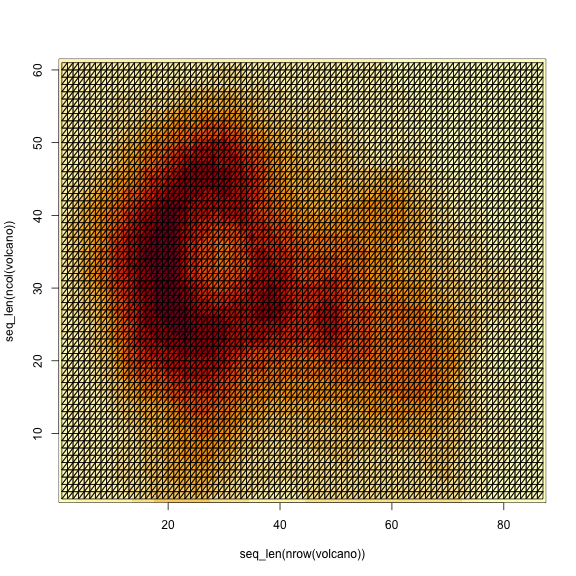
Fully triangulating a height field always requires
(M-1) * (N-1) * 2 triangles, but some models have large
smooth regions where this level of detail is unnecessary. Detailed
meshes are memory hungry, output to large models when saved to disk, and
can be difficult for slower systems to handle when plotted in 3D. We can
use terrrainmeshr to perform a triangulation of the height
field that maintains a user-specified amount of total error in the
model, or uses a set number of triangles.
First, let’s try triangulating the matrix without any loss of
precision (by setting maxError = 0).
library(terrainmeshr)

tris = triangulate_matrix(volcano, maxError = 0, verbose = TRUE)
#> 35.3% reduction: Number of triangles reduced from 10614 to 6867. Error: 0.000000
image(x=seq_len(nrow(volcano)), y = seq_len(ncol(volcano)), volcano)
plot_polys(tris)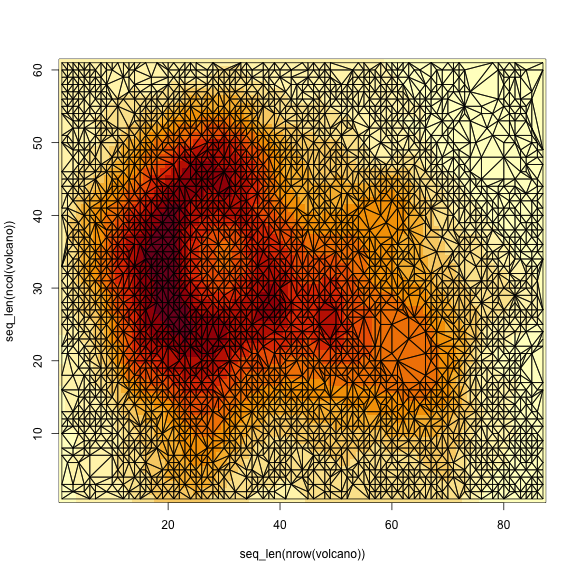
Here, triangulating the matrix resulted in a 35% reduction in the number of triangles required, with no additional error. Let’s try setting a maximum number of triangles to use, or set the maximum allowable error value to a small finite number:
tris1 = triangulate_matrix(volcano, maxTriangles = 200, verbose = TRUE)
#> 98.1% reduction: Number of triangles reduced from 10614 to 200. Error: 5.799988
image(x=seq_len(nrow(volcano)), y = seq_len(ncol(volcano)), volcano)
plot_polys(tris1)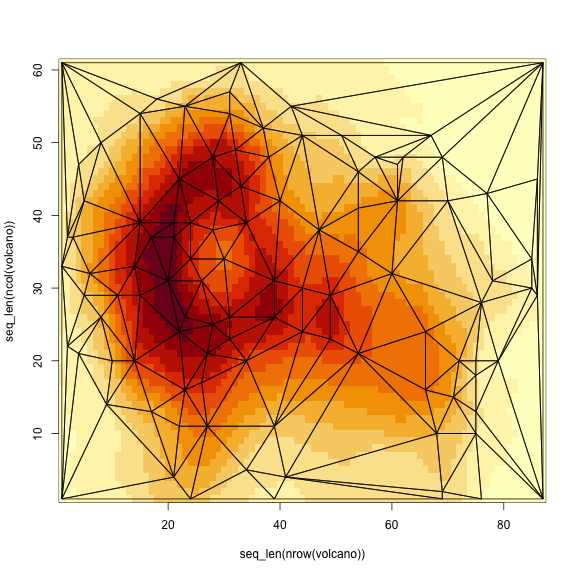
tris2 = triangulate_matrix(volcano, maxError = 2, verbose = TRUE)
#> 91.7% reduction: Number of triangles reduced from 10614 to 878. Error: 2.000000
image(x=seq_len(nrow(volcano)), y = seq_len(ncol(volcano)), volcano)
plot_polys(tris2)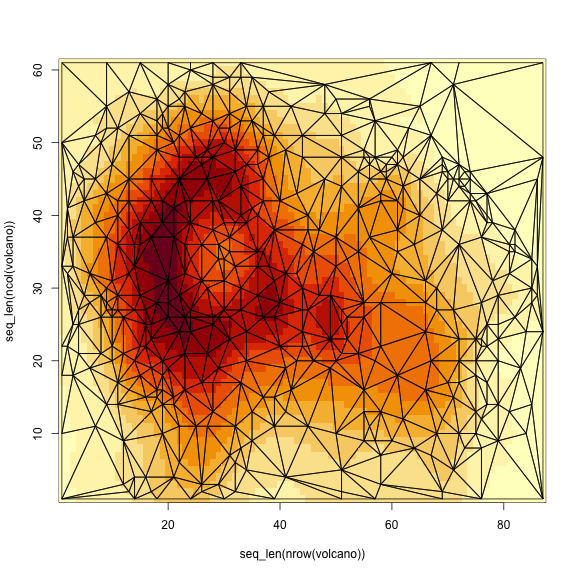
By setting the allowable maximum error to 2, we have reduced the size of the model to over 1/10th it’s original size. We also computed a minimum-error model with a set number of triangles. Let’s inspect the max error model in 3D and compare it (green) to the full triangulated version (red). We’ll load the rayshader and rgl packages to help with plotting the models in 3D.
library(rayshader)
library(rgl)

tri_volcano[,3] = -tri_volcano[,3]

par3d(windowRect=c(0,0,600,600))
rgl::rgl.triangles(tris2, color="green", lit=TRUE)
#> Warning in rgl::rgl.triangles(tris2, color = "green", lit = TRUE): 'rgl::rgl.triangles' is deprecated.
#> Use 'triangles3d' instead.
#> See help("Deprecated")
rgl::rgl.triangles(tri_volcano, color="red", lit=TRUE)
#> Warning in rgl::rgl.triangles(tri_volcano, color = "red", lit = TRUE): 'rgl::rgl.triangles' is deprecated.
#> Use 'triangles3d' instead.
#> See help("Deprecated")
bg3d(color="black")

par(mfrow=c(2,2))
render_camera(phi=30,fov=0,theta=45,zoom=0.9)
render_snapshot()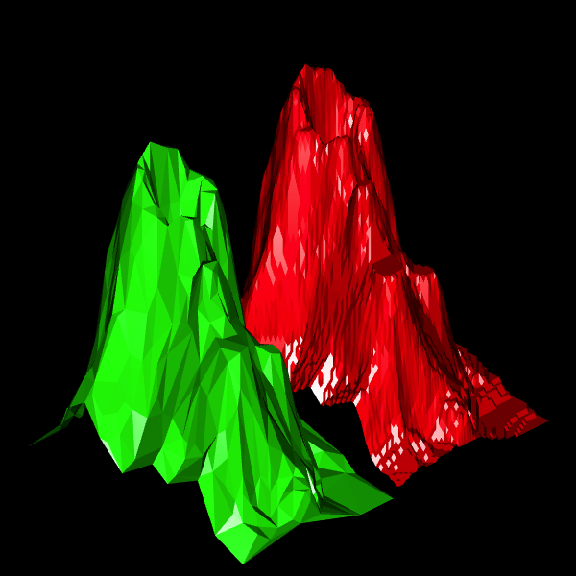
render_camera(phi=30,fov=0,theta=135,zoom=0.9)
render_snapshot()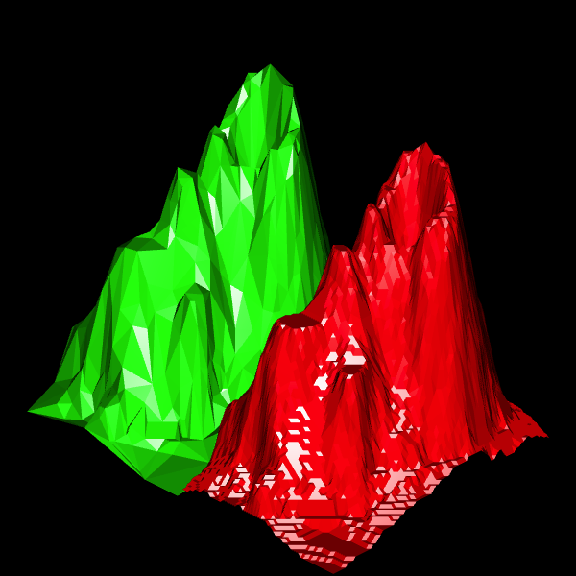
render_camera(phi=30,fov=0,theta=225,zoom=0.9)
render_snapshot()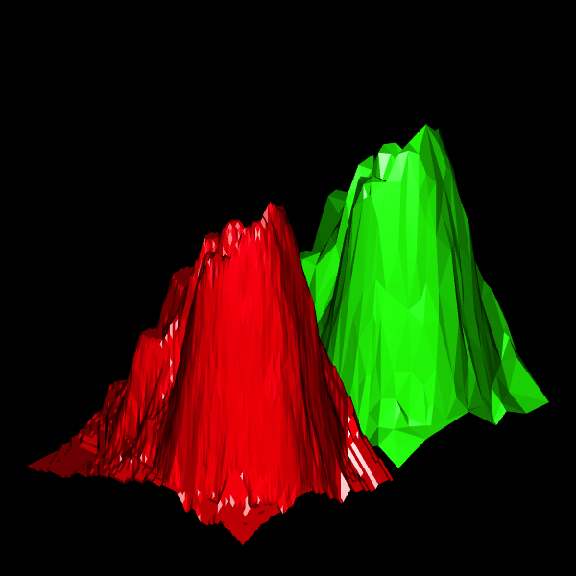
render_camera(phi=30,fov=0,theta=315,zoom=0.9)
render_snapshot()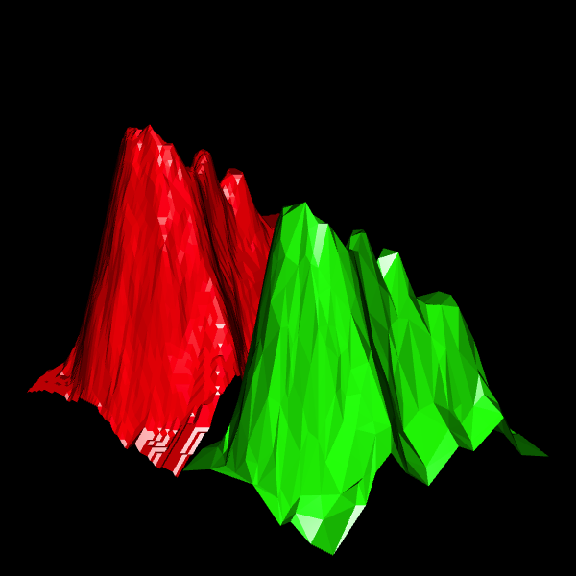
par(mfrow=c(1,1))

rgl.close()
#> Warning in rgl.close(): 'rgl.close' is deprecated.
#> Use 'close3d' instead.
#> See help("Deprecated")
With minimal loss of detail, we have computed a 3D model that is a good approximation to the original surface, with far fewers polygons used.
Now, let’s add a texture and compute the lighting ourselves with the rayshader package using the hi-res mesh, and apply that texture to the low-res approximation. Using the texture and lighting computed from the full resolution mesh with the low-resolution mesh can give the appearance of small details without the computational expense of displaying the full mesh.
temp_texture = tempfile(fileext = ".png")

#Compute the texture using the full-resolution mesh and save it to file
volcano %>%
  sphere_shade() %>%
  add_shadow(ray_shade(volcano)) %>%
  save_png(temp_texture)

#Compute the texcoords for the 3D mesh
texcoords = tris2[,c(1,3)]
texcoords[,1] = texcoords[,1]/max(texcoords[,1])
texcoords[,2] = texcoords[,2]/max(texcoords[,2])

texcoords2 = tri_volcano[,c(1,3)]
texcoords2[,2] = -texcoords2[,2]
texcoords2[,1] = texcoords2[,1]/max(texcoords2[,1])
texcoords2[,2] = 1-texcoords2[,2]/max(texcoords2[,2])

#Plot the two volcanos, side by side
par3d(windowRect=c(0,0,600,600))

rgl::rgl.triangles(tris2, lit=FALSE, texture = temp_texture, texcoords = texcoords)
#> Warning in rgl::rgl.triangles(tris2, lit = FALSE, texture = temp_texture, : 'rgl::rgl.triangles' is deprecated.
#> Use 'triangles3d' instead.
#> See help("Deprecated")
rgl::rgl.triangles(tri_volcano,  lit=FALSE, texture = temp_texture, texcoords = texcoords2)
#> Warning in rgl::rgl.triangles(tri_volcano, lit = FALSE, texture = temp_texture, : 'rgl::rgl.triangles' is deprecated.
#> Use 'triangles3d' instead.
#> See help("Deprecated")
bg3d(color="black")

par(mfrow=c(2,2))
render_camera(phi=30,fov=0,theta=45,zoom=0.9)
render_snapshot()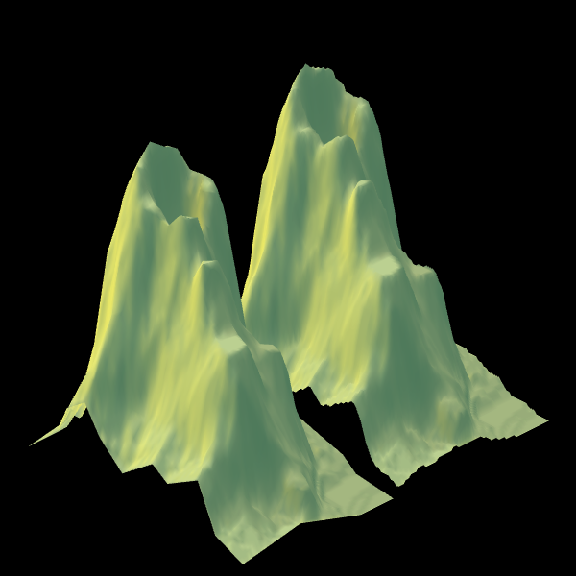
render_camera(phi=30,fov=0,theta=135,zoom=0.9)
render_snapshot()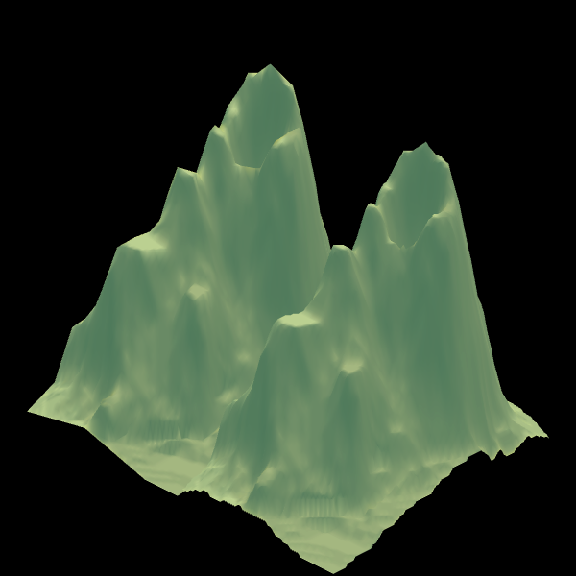
render_camera(phi=30,fov=0,theta=225,zoom=0.9)
render_snapshot()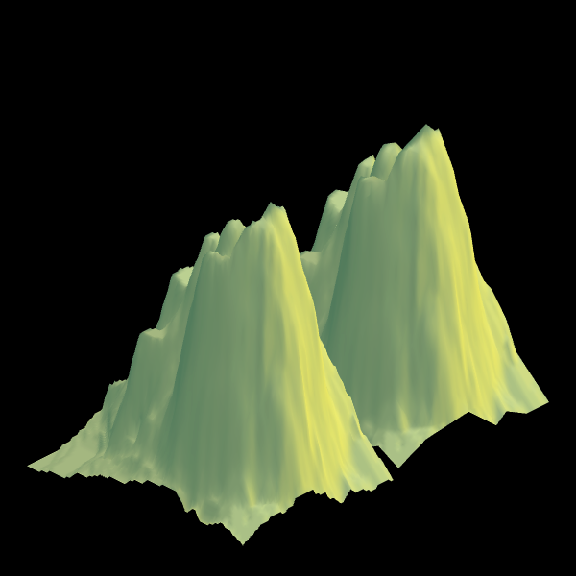
render_camera(phi=30,fov=0,theta=315,zoom=0.9)
render_snapshot()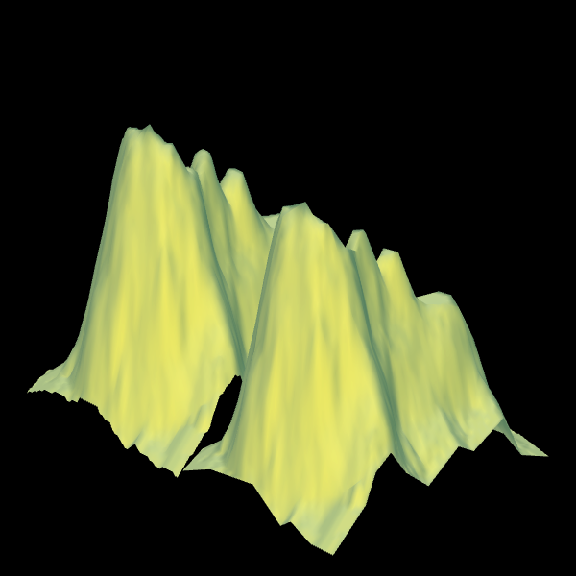
We see that there is only a small perceivable difference between the two models, despite one of them being 1/10th the size of the other.