FUTure Urban-Regional Environment Simulation (FUTURES)
DESCRIPTION
r.futures.* is an implementation of FUTure Urban-Regional Environment Simulation (FUTURES) which is a model for multilevel simulations of emerging urban-rural landscape structure. FUTURES produces regional projections of landscape patterns using coupled submodels that integrate nonstationary drivers of land change: per capita demand (DEMAND submodel), site suitability (POTENTIAL submodel), and the spatial structure of conversion events (PGA submodel).
Submodels
DEMAND
DEMAND estimates the rate of per capita land consumption specific to
each subregion. Projections of land consumption are based on
extrapolations between historical changes in population and land
conversion based on scenarios of future population growth. How to
construct the per capita demand relationship for subregions depends on
user's preferences and data availability. Land area conversion over time
can be derived for the USA, e.g. from National Land Cover Dataset. A
possible implementation of the DEMAND submodel is available as tool
r.futures.demand.
POTENTIAL
The POTENTIAL submodel uses site suitability modeling approaches to
quantify spatial gradients of land development potential. The model uses
multilevel logistic regression to account for hierarchical
characteristics of the land use system (variation among jurisdictional
structures) and account for divergent relationships between predictor
and response variables. To generate a binary, developed-undeveloped
response variable using a stratified-random sample, see tool
r.sample.category. The coefficients for the
statistical model that are used to calculate the value of development
potential can be derived with tool
r.futures.potential, which uses multilevel
logistic regression in R. One of the predictor variables is development
pressure (computed using
r.futures.devpressure) which is updated
each step and thus creates positive feedback resulting in new
development attracting even more development.
PGA
Patch-Growing Algorithm is a stochastic algorithm, which simulates
undeveloped to developed land change by iterative site selection and a
contextually aware region growing mechanism. Simulations of change at
each time step feed development pressure back to the POTENTIAL submodel,
influencing site suitability for the next step. PGA is implemented in
r.futures.simulation.
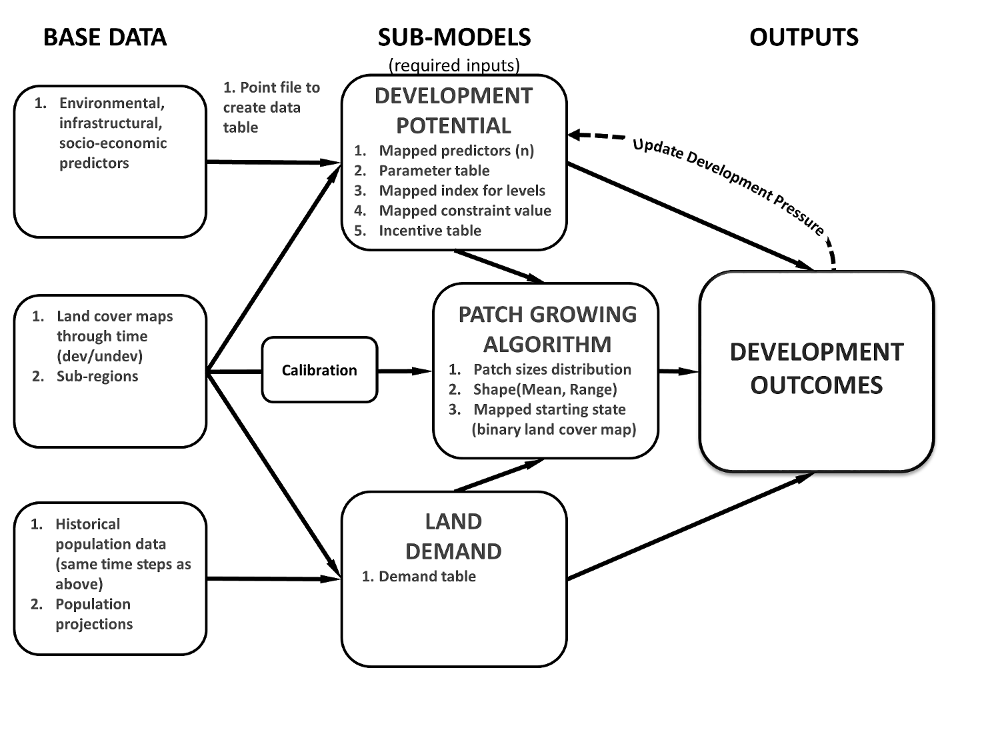
Figure: FUTURES submodels and input data
Input data
We need to collect the following data:
Study extent and resolution
Specified with g.region command.
Subregions
FUTURES is designed to capture variation across specified subregions
within the full study extent. Subregions can be for example counties.
DEMAND and POTENTIAL can both be specified according to subregions.
Subregion raster map contains the subregion index for each cell as
integer starting from 1. If you do not wish to model by subregion, all
values in this map should be 1.
Population data
DEMAND submodel needs historical population data for each subregion for
reference period and population projections for the simulated period.
Development change
Based on the change in developed cells in the beginning and end of the
reference period, and the population data, DEMAND computes how many
cells to convert for each region at each time step. Development change
is also used for deriving the patch sizes and shape in calibration step
(see r.futures.calib) to be used in PGA
submodel. DEMAND and PGA require a raster map representing the starting
state of the landscape at the beginning of the simulation (developed =
1, available for development = 0, excluded from development as NULLs).
Predictors
Development potential (POTENTIAL submodel) requires a set of
uncorrelated predictors (raster maps) driving the land change. These can
include distance to roads, distance to interchanges, slope, ...
Development pressure
The development pressure variable is one of the predictors, but it is
recalculated at each time step to allow for positive feedback (new
development attracts more development). For computing development
pressure, see r.futures.devpressure.
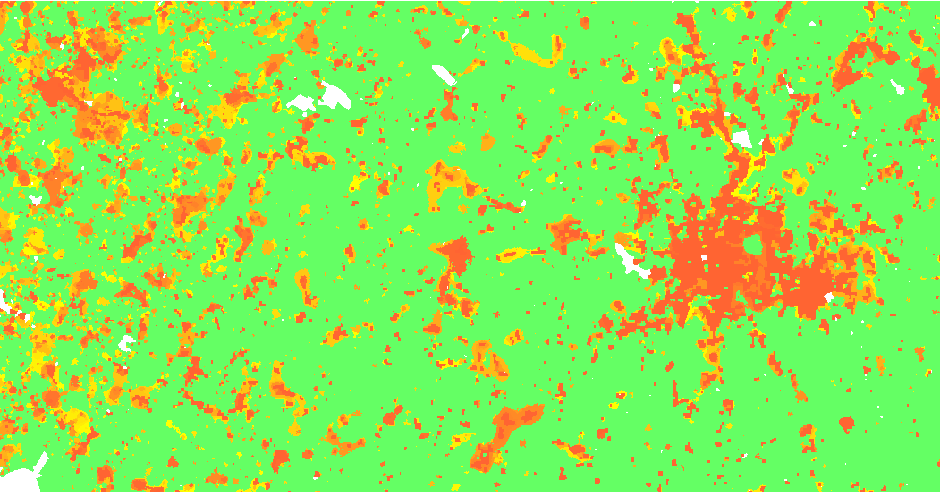
Figure: FUTURES simulation result
EXAMPLE
Simple example using nc_spm_08_grass7 dataset. Please see tutorials on GRASS wiki for more realistic examples.
Create rasters representing urbanization using NDVI, exclude lakes:
g.region raster=lsat7_2002_30@PERMANENT
i.vi red=lsat7_2002_30@PERMANENT output=ndvi_2002 nir=lsat7_2002_40@PERMANENT
i.vi red=lsat5_1987_30@landsat output=ndvi_1987 nir=lsat5_1987_40@landsat
r.mapcalc expression="urban_1987 = if(ndvi_1987 <= 0.1 && isnull(lakes), 1, if(isnull(lakes), 0, null()))"
r.mapcalc expression="urban_2002 = if(ndvi_2002 <= 0.1 && isnull(lakes), 1, if(isnull(lakes), 0, null()))"
Create predictors - slope, distance from lakes in km, distance from roads in km, development pressure:
r.slope.aspect elevation=elevation slope=slope

r.grow.distance input=lakes distance=lakes_dist
r.mapcalc "lakes_dist_km = lakes_dist/1000."

v.to.rast input=streets_wake output=streets use=val
r.grow.distance input=streets distance=streets_dist
r.mapcalc "streets_dist_km = streets_dist/1000."

r.futures.devpressure input=urban_2002 output=devpressure method=gravity size=15 -n
Sample predictors and developed areas:
r.sample.category input=urban_2002 output=sampling sampled=slope,lakes_dist_km,streets_dist_km,devpressure,zipcodes npoints=300,100
Compute POTENTIAL regression coefficients, using zipcodes as subregion:
r.futures.potential input=sampling output=potential.csv columns=devpressure,slope,lakes_dist_km,streets_dist_km developed_column=urban_2002 subregions_column=zipcodes
Compute how many cells should be converted in each subregion:
r.futures.demand development=urban_1987,urban_2002 subregions=zipcodes observed_population=observed_population.csv projected_population=projected_population.csv \
  simulation_times=2003,2004,2005,2006,2007,2008,2009,2010 method=linear,logarithmic,exponential demand=demand.csv
Create a list of patch sizes (here we skip calibration of patch sizes for simplicity):
r.futures.calib -l development_start=urban_1987 development_end=urban_2002 patch_threshold=0 patch_sizes=patches.txt subregions=zipcodes --o
Run patch growing to get final results:
r.futures.simulation developed=urban_2002 subregions=zipcodes output=futures output_series=futures predictors=slope,lakes_dist_km,streets_dist_km devpot_params=potential.csv \
  development_pressure=devpressure n_dev_neighbourhood=15 development_pressure_approach=gravity gamma=1.5 scaling_factor=1 demand=demand.csv discount_factor=0.1 \
  compactness_mean=0.4 compactness_range=0.05 num_neighbors=4 seed_search=probability patch_sizes=patches.txt random_seed=1
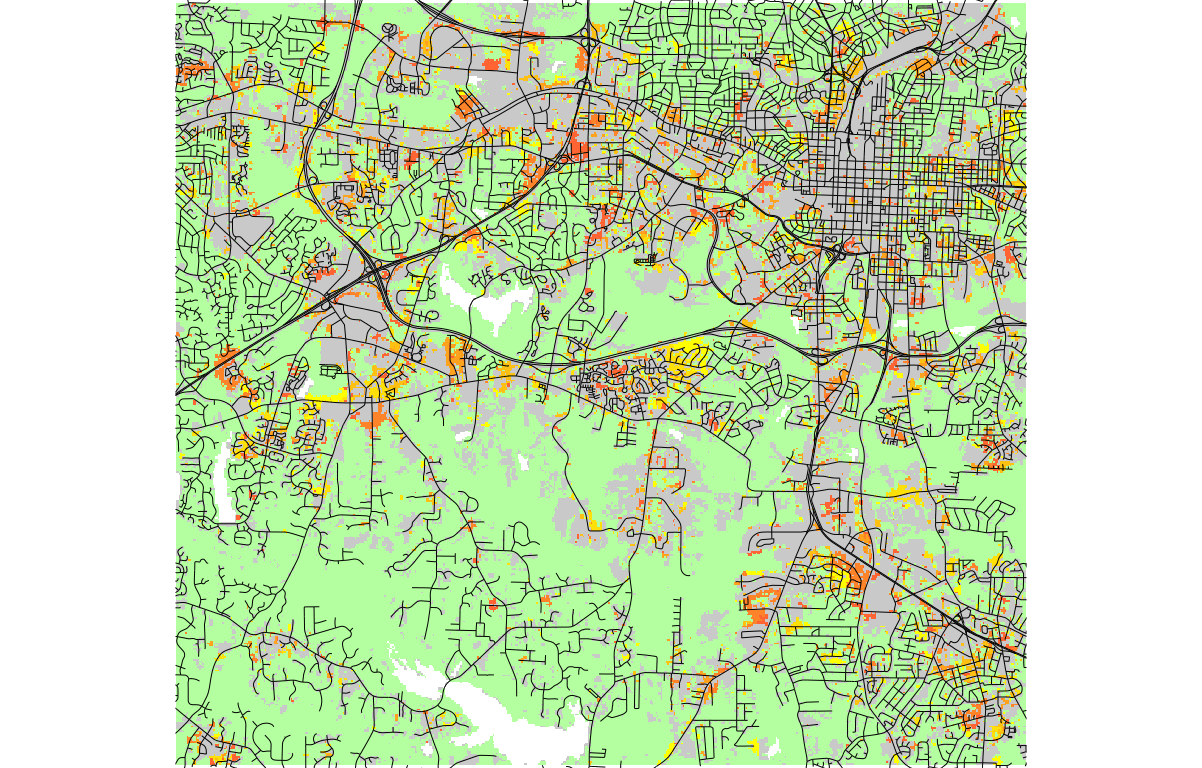
Figure: One stochastic realization of FUTURES simulation, orange
to yellow gradient represents new development where yellow is the
latest.
REFERENCES
- Meentemeyer, R. K., Tang, W., Dorning, M. A., Vogler, J. B., Cunniffe, N. J., & Shoemaker, D. A. (2013). FUTURES: Multilevel Simulations of Emerging Urban-Rural Landscape Structure Using a Stochastic Patch-Growing Algorithm. Annals of the Association of American Geographers, 103(4), 785-807. DOI: 10.1080/00045608.2012.707591
- Dorning, M. A., Koch, J., Shoemaker, D. A., & Meentemeyer, R. K. (2015). Simulating urbanization scenarios reveals tradeoffs between conservation planning strategies. Landscape and Urban Planning, 136, 28-39. DOI: 10.1016/j.landurbplan.2014.11.011
- Petrasova, A., Petras, V., Van Berkel, D., Harmon, B. A., Mitasova, H., & Meentemeyer, R. K. (2016). Open Source Approach to Urban Growth Simulation. Int. Arch. Photogramm. Remote Sens. Spatial Inf. Sci., XLI-B7, 953-959. DOI: 10.5194/isprsarchives-XLI-B7-953-2016
- Sanchez, G.M., A. Petrasova, A., M.M. Skrip, E.L. Collins, M.A. Lawrimore, J.B. Vogler, A. Terando, J. Vukomanovic, H. Mitasova, and R.K. Meentemeyer. 2023. Spatially interactive modeling of land change identifies location-specific adaptations most likely to lower future flood risk. Sci Rep 13, 18869. DOI: https://doi.org/10.1038/s41598-023-46195-9
SEE ALSO
r.futures.simulation, r.futures.parallelpga, r.futures.devpressure, r.futures.calib, r.futures.demand, r.futures.potential, r.futures.potsurface, r.futures.gridvalidation, r.futures.validation, r.sample.category
AUTHORS
Corresponding author: Anna Petrasova, akratoc ncsu edu, Center for Geospatial Analytics, NCSU
Original standalone version: Ross K. Meentemeyer, Wenwu Tang, Monica A. Dorning, John B. Vogler, Nik J. Cunniffe, Douglas A. Shoemaker (Department of Geography and Earth Sciences, UNC Charlotte) Jennifer A. Koch (Center for Geospatial Analytics, NCSU)
Port to GRASS and GRASS-specific additions: Vaclav Petras, NCSU GeoForAll
Development pressure, demand, calibration, validation, preprocessing tools and maintenance: Anna Petrasova, NCSU GeoForAll
Climate forcing submodel:
Anna Petrasova,
NCSU GeoForAll
Georgina Sanchez,
Center for Geospatial Analytics, NCSU
Zoning:
Margaret Lawrimore,
Center for Geospatial Analytics, NCSU
Anna Petrasova,
NCSU GeoForAll
SOURCE CODE
Available at: r.futures source code
(history)
Latest change: Friday Apr 17 16:26:46 2026 in commit bc11ef4